The Importance of Lithium-ion Battery Safety for Material Handling Applications
Lithium-ion batteries are providing the world with energy storage that is required for the electrification of transportation and material handling and is an enabling technology for everything from smart phones and consumer electronics to renewable energy. There is no doubt that this is the most important technology for the fight against climate change and reduction in Greenhouse gas emissions around the world. However, storing energy always comes with risks, and lithium-ion batteries are no exception. Due to the high energy density, safety incidents can become critical very quickly. This becomes more of a challenge for larger systems, such as those used in passenger electric vehicles and material handling equipment.
For instance, while a fire in a vehicle outdoors is concerning and should be taken very seriously, a fire within a warehouse, where equipment and fire hazards are closely packed, it can be extremely deadly. A fire at a distribution center operated for Amazon in Redlands California in June 2020, quickly escalated and resulted in the entire 100,000 square foot facility being destroyed https://www.cnn.com/2020/06/05/us/amazon-redlands-fire-trnd/index.html. This not only resulted in millions of dollars in lost property, but also endangers the safety of staff. As distribution centers can often have up to hundreds of electric forklift trucks in operation, there is a significant number of batteries operating at any given time.
To ensure safety of batteries, several key areas are fundamental, namely the lithium-ion cell, the battery management system (BMS) and the overall system design of the battery.
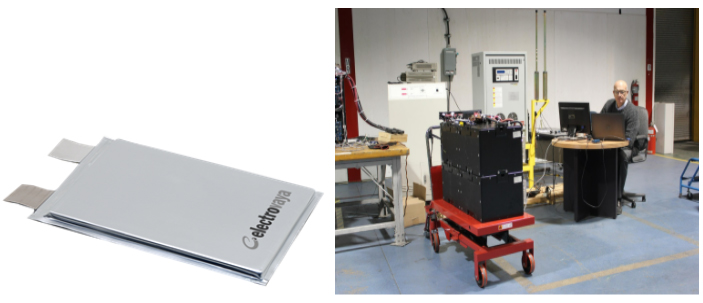
Most important is the lithium-ion cell itself. Here is where Electrovaya’s batteries are sharply differentiated as Electrovaya utilizes proprietary technologies like ceramic composite separator materials and unique cell design methods which ensures the cells can surpass the most difficult safety testing. The Electrovaya EV-44 cell is certified under numerous UL designations and is relatively difficult to fail due to its high temperature stability.
Another key piece of technology that is key to ensure the safety of the battery system is the BMS, which is a combination of hardware and software that ensures the battery is operating under safe conditions by monitoring all the lithium-ion cell temperatures, voltage, charging current, discharging current and other parameters. The Electrovaya battery management system is able to shut down the battery if it detects unsafe conditions and is also able to communicate to the vehicle and charger and regulate behaviour on those devices as well. Finally, the Electrovaya BMS logs all data and is able to transmit battery usage, performance and troubleshooting data to a proprietary data analytics site.
Finally, the overall system design is also critical to the safety of the battery design. Here, Electrovaya provides a holistic approach to the system design following a rigorous Design Failure Mode and Effect Analysis (DFEMA) process. Electrovaya utilizes several key approaches to ensure that the battery can withstand significant failures and remain safe. This is why Electrovaya was successful with its UL 2580 certification which is UL certification for batteries for electric vehicles.

In conclusion, energy storage is always something to be taken with caution and care. Whether this is a fuel tank, a hot cup of coffee or a lithium-ion battery, these devices can always cause harm if mishandled. Electrovaya through some key technologies and system engineering provides a solution which mitages safety challenges for lithium-ion batteries and provides warehouse operators with peace of mind.

Raymond and Electrovaya Announce Strategic Supply Agreement
Toronto, Ontario– December 18th, 2020 – Electrovaya Inc. (“Electrovaya”) (TSX:EFL) (OTCQB:EFLVF)

Modex 2020

The Battery Show

The Global Cold Chain Expo
What’s the right battery-charger pairing? An interplay of battery, charger, and battery:charger ratio
For businesses with a forklift fleet requiring daily and multiple lead acid battery (LAB) changes or other power sources (e.g. fuel cell) that are failing to keep up with operational demands, converting to lithium ion batteries (LIBs) could be the perfect move. Electrovaya has been a leader in the LIB space, especially for material handling applications. Electrovaya’s core technology is modular in design, enabling battery capacity offerings to be diverse to better match applications with differing energy requirements. As an example, Electrovaya’s 36V LIB family comes in a 528, 792, and 1056 Ah format. Similarly, Electrovaya’s charger offerings come in various current output sizes such as a 250A, 320A, and 500A format to complement the battery sizing and user application.
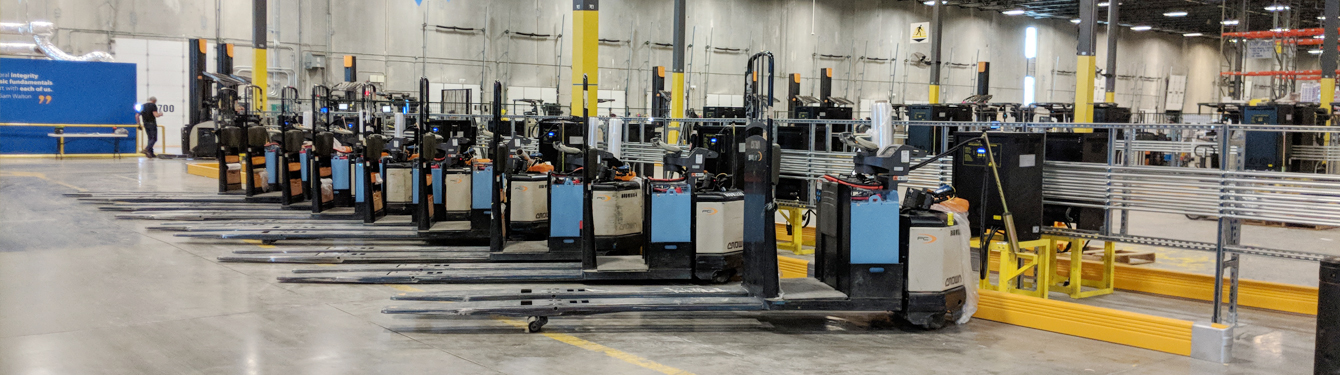
With multiple offerings available for both batteries and chargers, selecting the right battery and charger combination could be a challenging decision. Moreover, Electrovaya’s LIBs could be quickly charged in a short period of time, a factor that supports having less charger equipment than batteries. As an example, one of Electrovaya’s food distribution customers pair one charger with every three batteries.
As there are numerous possible combinations of battery types, charger types, and battery:charger quantity ratios, the following three most common scenarios will shed some light into their pros and cons.
The first scenario consists of a large battery (i.e. high capacity) paired with a large charger (i.e. high current output) in a 1:1 ratio. The advantages of the large battery ensures that there is ample "juice" to power a forklift for a long time before requiring a charge and furthermore, permits the battery to perform extended stressful workloads including carrying and lifting heavy pallets to high heights over 400”. The advantage of the large charger is that it will fast charge the battery and replenish the battery charge level quickly, while the 1:1 ratio ensures that each battery will see a charger at every opportunity break. This would ensure that the battery charge level stays sufficiently high. The disadvantages are that this is the most capital intensive package that requires a large footprint for the charging area. Secondly, an electrical infrastructure upgrade is likely required to handle the high power output from the large chargers. This setup is best suited for heavy-duty operations involving frequently heavy loads and high lifts especially above 400".
The second scenario consists of a large battery paired with a large charger in a 2:1 ratio. The advantages are that the charger area footprint is halved and the cost is lower than the first scenario. This combination is also future-proof and that if workload was to increase indefinitely, additional chargers could be procured to support the operation. In other words, a conversion to a Scenario 1 setup is feasible. The disadvantages are that half of the battery fleet could only be charged during an opportunity break and an electrical infrastructure upgrade is likely required. The opportunity charging matter could be mitigated by staggering breaks. This setup is best suited for operations dealing with moderately heavy loads and high lifts.
The third scenario consists of a small battery (i.e. lower capacity) paired with a small charger (i.e. lower current output) in a 1:1 ratio. The advantages are that it is the lowest cost package of the three cases, charger area footprint is slightly smaller relative to Scenario 1 due to a smaller form factor of the charger, there is no sharing of chargers during opportunity breaks, and an electrical infrastructure upgrade is very likely not required. The disadvantages are shorter battery runtime requiring more frequent charging and a limitation in duration of performing extended stressful workloads. This setup is also not future-proof to accommodate indefinite increased workload and could require additional new batteries (and chargers) to be procured to support operation needs. The recommended application is for low-to-moderate loads and lifts.
Please consult with a sales representative (sales@electrovaya.com) for further details about what’s the best package for you.
| Scenario No. | Pros | Cons | Recommended Users |
| S1: Large Battery, Large Charger, 1:1 Ratio | -Runtime-Stress load capability-100% charging opportunity | -Charger area footprint-Electrical infrastructure upgrade-Cost | -Heavy loads and high lifts (>400") |
| S2: Large Battery, Large Charger, 1:2 Ratio | -Runtime-Stress load capability-Charger area footprint-Cost (slightly lower) | -50% charging opportunity-Electrical infrastructure upgrade | -Moderately heavy loads and high lifts (<400") |
| S3: Smaller Battery, Smaller Charger, 1:1 Ratio | -Cost-Electrical infrastructure upgrade not required-Charger area footprint (slightly smaller)-100% charging opportunity | -Runtime-Stress load capability | -Low-to-moderate loads and lifts |

ProMat 2019